Tuesday, February 12, 2013

Irony


     Merriam-Webster’s defines “irony” as the “incongruity between the actual result of a sequence of events and the normal or expected result”. With this understanding, it is astonishing how human thought can be so ironic! As I revive this column, I wish to call our attention to this reality, while I invite everyone to do what this column title intends to do: “Cogito” (I think).

     In the front page of The Philippine Star last Wednesday (February 6), I came across this photo of several supposedly naked women models (nine of them), each holding a placard that seemingly serves as the only cover to one’s private parts. All their placards read: “Naked truth is: Mali, the elephant suffering!”
 
     The caption says: “Models and entertainers hold placards during a photo shoot for a new ad for animal rights group People for the Ethical Treatment of Animals in Makati City... PETA seeks the transfer of Mali, the elephant, from solitary confinement at the Manila Zoo to a sanctuary in Thailand”.

      Here’s the irony: to support for the “ethical treatment of animals”, this group (PETA) has to strip naked nine respectable women and cover them only with placards.
   
     Is that the way we “ethically treat” human beings? Does ethical treatment of animals need to “unethically treat” women? Maybe just to call our attention, eh! But calling one’s attention need not be unethical to the dignity of human persons. I wonder how many ironic thinking we, human beings, show!
 * * *

Here’s another one!

      At the height of the RH bill debate last year, a good number of Ateneo de Manila University professors expressed their support for the bill, despite the fact that, while they were giving classes in a Catholic school, they were defying the Catholic authority – the Magisterium of the Church. Responding to the people’s confusion on this issue (How could a Catholic university tolerate such an anti-Catholic stand?), one Jesuit priest made a very subtle distinction: “Ateneo is not a Catholic school, but a school where Catholics go”. Very clever!

      But where’s the irony? The irony is that some of these professors belong to a group that calls itself “Catholics for RH” (C4RH). Just recently, they held a symposium here in Davao wherein they argued that RH law can be compatible with the Catholic doctrine. How ironic!

      Are they really Catholics? If they are (as their group name suggests), then why would they embrace an anti-Catholic stand on RH law? Since they could not make the Catholic Church pro-RH law, they are now trying to make the RH law Catholic! What a shame!

      Truly, “si no vives como piensas, acabarás pensando como vives” (If you don’t live according to how you believe, you will end up believing according to how you live).

Friday, March 16, 2012

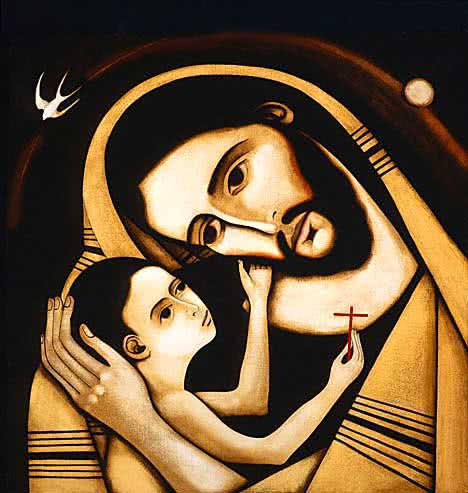
St. Joseph, Father of the New Evangelization


Benedict XVI Entrusts to His Patron All the Pastors of the Universal Church

By Anita Bourdin

ROME, MARCH 15, 2012 (Zenit.org).- March is the month of St. Joseph, whose feast the Church will celebrate Monday. Currently the holy patron of Vatican II is now seen as the “Father of the New Evangelization” and “the holy patron of the third millennium,” according to an initiative launched by the bishop of the French diocese of Frejus-Toulon, Bishop Dominique Rey

On Saturday, the Diocese of Frejus-Toulon will be consecrated to Saint Joseph.

Saint Joseph had a special role in the preparation of Vatican Council II, given that Pope John XXIII chose him as a protector of the event, with his Apostolic Letter of March 19, 1961. In the text, Blessed John XXIII mentions “the voices that come to Us from all points of the earth” and the documents on Saint Joseph of his predecessors, from Pius IX to Pius XIII. In his document, the Pope proposed, in addition, that on March 19, Saint Joseph’s altar in the Vatican Basilica “be clothed in new splendor, wider and more solemn” to become a “point of attraction and religious piety for individual souls, for innumerable crowds.”

Then, in October of 1962, he made a gift of his papal ring to Joseph, offering it to the Polish shrine of Kalisz, where a painting of Saint Joseph is kept, which is considered miraculous.

It was Blessed John XXIII, moreover, who had Saint Joseph’s name inserted in the Canon of the Mass, as he announced in his address at the closing of the first session of the Council on Dec. 8, 1962.

The Shrine at Knock

John Paul II in turn gave his ring to Saint Joseph, to whom he had also been devoted since his childhood. The ring was placed by Cardinal Franciszek Macharski, archbishop of Krakow, in the church of Carmel, a shrine dedicated to Saint Joseph, on March 19, 2004.

The Polish Pope recalled the importance of Saint Joseph for the life of the Church in his Apostolic Exhortation Redemptoris Custos (August 15, 1989), a century after Pope Leo XIII’s encyclical Quanquam Pluries (August 15, 1889) on devotion to Saint Joseph.

For his part, Benedict XVI announced recently a Year of Faith, starting on the 50th anniversary of Vatican II. On many occasions, Benedict XVI has invited Catholics to learn from the school of Saint Joseph, to have a “spiritual conversation” with him, linked to a renewal of faith. Before the Angelus on December 18, 2005, for example, he said: “It is therefore particularly appropriate in the days that precede Christmas to establish a sort of spiritual conversation with St Joseph, so that he may help us live to the full this great mystery of faith.”

On March 18, 2009, in Yaounde, Cameroon, the Pope dedicated his homily to his patron saint. Addressing all the people of God, he concluded saying that in Saint Joseph there is no separation between faith and action.

“Dear brothers and sisters, our meditation on the human and spiritual journey of Saint Joseph invites us to ponder his vocation in all its richness, and to see him as a constant model for all those who have devoted their lives to Christ in the priesthood, in the consecrated life or in the different forms of lay engagement. Joseph was caught up at every moment by the mystery of the Incarnation. Not only physically, but in his heart as well, Joseph reveals to us the secret of a humanity which dwells in the presence of mystery and is open to that mystery at every moment of everyday life. In Joseph, faith is not separated from action. His faith had a decisive effect on his actions. Paradoxically, it was by acting, by carrying out his responsibilities, that he stepped aside and left God free to act, placing no obstacles in his way. Joseph is a 'just man' (Mt 1:19) because his existence is 'ad-justed' to the word of God.”

The Year for Priests

On December 19, 2010, the 4th Sunday of Advent, Benedict XVI reflected before the Angelus on the Announcement to Joseph, entrusting to his protection all priests worldwide, stressing his role of “legal Father” of Jesus in God’s plan of salvation. “In witnessing to Mary’s virginity, to God’s gratuitous action and in safeguarding the Messiah’s earthly life St Joseph announces the miracle of the Lord. Therefore let us venerate the legal father of Jesus (cf. Catechism of the Catholic Church, n. 532), because the new man is outlined in him, who looks with trust and courage to the future. He does not follow his own plans but entrusts himself without reserve to the infinite mercy of the One who will fulfil the prophecies and open the time of salvation.” said the Pope.

“Dear friends, I would like to entrust all Pastors to St Joseph, universal Patron of the Church, while I urge them to offer “Christ’s [humble] words and actions each day to the faithful and to the whole world”, (Letter Proclaiming the Year for Priests, 16 June 2009).),” he continued.

Brother Andre and Cotignac

On Sunday, October 17, 2010, the Pope canonized in Rome the Canadian Religious apostle of Saint Joseph, Brother Andre Bessette (1845-1937), who had Saint Joseph’s Oratory in Montreal built, of which he was custodian until his death.

For its part, the Diocese of Frejus-Toulon has on its territory the shrine of Cotignac, entrusted to the Brothers of Saint John, where in June of 1660 the Holy Custodian appeared to a 22-year-old shepherd of Provence, Gaspard Ricard, pointing to a large rock and saying simply: “I am Joseph, move it and you will drink.”

Louis XIV, going on pilgrimage to Cotignac, only 10 days after his ascent to the throne, entrusted France to the protection of Saint Joseph the following year, on March 19, 1661.


Wednesday, November 10, 2010

‘Visible sign of the invisible God’

     “The joy which I feel at presiding this ceremony became all the greater when I learned that this shrine, since its beginnings, has had a special relationship with Saint Joseph. I have been moved above all by Gaudí's confidence when, in the face of many difficulties, filled with trust in divine Providence, he would exclaim, ‘Saint Joseph will finish this church’. So it is significant that it is also being dedicated by a Pope whose baptismal name is Joseph”.

     These words of Pope Benedict XVI, pronounced at the beginning of his homily last Sunday, November 7, 2010, before some 250,000 people, more than 7,000 of which filled every corner of the newly-consecrated Basilica of the Holy Family – a splendid work by Architect Antonio Gaudí (whose process of beatification is going on) – had moved hearts. And for many – me, among them – it was another happy “coincidence” in such a historical event of the local church of Barcelona, Spain. “Coincidence,” someone said, “is the name God uses when He wants to remain anonymous.”

     Coming from Tarragona with some 112 overseas Filipino workers in two buses, and with two brother-priests, Fr. Allan Rodriguez and Fr. Elizar Cielo, I had the grace to concelebrate with the Pope, together with hundreds of concelebrating priests. I had witnessed the warm welcome accorded to the Supreme Pontiff by the catalan people and those coming from other Spanish cities. The day before, the Holy Father went to a pilgrimage at Santiago de Compostela and presided there the Holy Eucharist in the afternoon on the occasion of its Jubilee Year.

     The Pope’s message in his homily, as usual, has stirred not only the hearts of the Catholic faithful, jubilant with the presence of their spiritual father, but also the consciences of Church critics, rabid even at the thought of getting near the defender of the family, of women’s rights, and of human life from womb to tomb. Though a great part of his homily is dedicated to a reflection on “beauty (which) calls us to freedom and draws us away from selfishness,” what called the attention especially of the media are the Pope’s words on these questions:

     “Life has changed greatly and with it enormous progress has been made in the technical, social and cultural spheres. We cannot simply remain content with these advances. Alongside them, there also need to be moral advances, such as in care, protection and assistance to families, inasmuch as the generous and indissoluble love of a man and a woman is the effective context and foundation of human life in its gestation, birth, growth and natural end. Only where love and faithfulness are present can true freedom come to birth and endure.

     For this reason the Church advocates adequate economic and social means so that women may find in the home and at work their full development, that men and women who contract marriage and form a family receive decisive support from the state, that life of children may be defended as sacred and inviolable from the moment of their conception, that the reality of birth be given due respect and receive juridical, social and legislative support. For this reason the Church resists every form of denial of human life and gives its support to everything that would promote the natural order in the sphere of the institution of the family.”

     The Pope has spoken right through the heart of Spain – a modern Spain whose heart has somehow forgotten that true human family must be anchored on the “indissoluble love of a man and a woman”, that the authentic promotion of women is their holistic and integral development, and that the genuine protect of life is from birth to death. In this sense, the Pope’s message also strikes through the heart of every human being of good will and of every person who values family and life more than any political ideology.

     Reflecting on the significance of consecrating the church, which was later declared a Minor Basilica, the Pope said: “What do we do when we dedicate this church? In the heart of the world, placed before God and mankind, with a humble and joyful act of faith, we raise up this massive material structure, fruit of nature and an immense achievement of human intelligence which gave birth to this work of art. It stands as a visible sign of the invisible God, to whose glory these spires rise like arrows pointing towards absolute light and to the One who is Light, Height and Beauty itself.”

     At the heart of a metropolis, a great city like Barcelona, stands majestic “the visible sign of the invisible God”. Every Catholic is also called to stand in the midst of the world to be a living sign of the God of life. “As I contemplate with admiration this sacred space of marvelous beauty, of so much faith-filled history, I ask God that in the land of Catalonia new witnesses of holiness may rise up and flourish, and present to the world the great service that the Church can and must offer to humanity: to be an icon of divine beauty, a burning flame of charity, a path so that the world may believe in the One whom God has sent (cf. Jn 6:29),” the Pope ended.

Friday, November 5, 2010

Priests still have a future

Pope Benedict XVI, in his Letter to the Seminarians, recounts his experience in December 1941 when he was “drafted for military service, the company commander asked each of us what we planned to do in the future. I answered that I wanted to become a Catholic priest. The lieutenant replied: ‘Then you ought to look for something else. In the new Germany priests are no longer needed’. I knew that this ‘new Germany’ was already coming to an end, and that, after the enormous devastation which that madness had brought upon the country, priests would be needed more than ever.”

The Pope notes that today, the situation is different. “Many people nowadays also think that the Catholic priesthood is not a ‘job’ for the future, but one that belongs more to the past.” One could often hear even parents – after being confided by their son that he wanted to become a priest – would say: “What can you get from that?”

But I think the Pope’s diagnosis fits more appropriately in the first world countries like USA, Spain, Germany, etc. Though there are particular similar cases in the Philippines, they are not yet so common. Stories like parents putting obstacle on their son’s vocation often end up in the Primetime Drama special of a national TV.

Here in Spain, for instance, a young lad’s decision to enter the seminary would raise more than one eyebrow. “What has happened to that boy?” “Isn’t he doing well with his career?” Encouraging the seminarians, the Pope says: “You, dear friends, have decided to enter the seminary and to prepare for priestly ministry in the Catholic Church in spite of such opinions and objections. You have done a good thing because people will always have need of God.”

Priests still have a future. In a sense, this is what the Pope wants to convey especially to the young people in a highly industrialized world. Oftentimes the vision of a dark future for priests is what prevents young candidates from discovering their priestly vocation. One’s personal concept of success as defined in terms of good and stable job, big salaries and a comfortable life makes the possibility of serving God through His Church something like a nightmare for some.

But the future of priests is not determined by these parameters. Authentically successful life is more than just having big salaries, a stable job and material comfort. Real success is when you find authentic meaning to your existence: why are you here and where are you going. There is real joy in giving one’s life for the good of others. I think, in this sense, the priests still and will always have a future.

The Pope’s reason for affirming that priests still have a future is decisive. He says, “People will always have need of God, even in an age marked by technical mastery of the world and globalization: they will always need the God who has revealed himself in Jesus Christ, the God who gathers us together in the Universal Church in order to learn with him and through him life’s true meaning and in order to uphold and apply the standards of true humanity.”

A priest’s life still has a future because people will always need God to give meaning to their existence. People will still priests because they will always need God. “Where people no longer perceive God, life grows empty; nothing is ever enough. People then seek escape in euphoria and violence; these are the very things that increasingly threaten young people.”

Lastly, priests still have a future because, as the Pope rightly observes, “God is alive, and he needs people to serve him and bring him to others.” Perhaps, this is something that seminarians must reflect every day. God needs you to bring Him to others. Psychologists say that one of man’s deepest needs is the need to be needed. Well, here it is: “It does make sense to become a priest: the world needs priests, pastors, today, tomorrow and always, until the end of time.”

Tuesday, October 26, 2010

Quid divinum

“Hay un algo santo, divino, escondido en las situaciones más comunes, que toca a cada uno de vosotros descubrir” (There is something holy, something divine hidden in the most ordinary situations, and it is up to each one of you to discover it).

In these few words, Saint Josemaría Escrivá described the message he was preaching all the years of his existence, since the founding of Opus Dei, a Catholic institution whose mission is “to help people turn their work and daily activities into occasions for growing closer to God, for serving others, and for improving society” (For more information, see http://www.opusdei.us/sec.php?s=8). The quotation is from his well-known homily entitled “Passionately loving the world”, which he pronounced on October 8, 1967 at a Mass on the campus of the University of Navarre, Spain. The homily has helped thousands of people find their vocation in life and continues to move hearts and mind.

On October 23 this year, the Prelate of Opus Dei, Bishop Javier Echevarria, second successor of Saint Josemaría, presided over the Holy Eucharist on the same spot where some 43 years ago, the Founder of Opus Dei celebrated it. This time, the occasion was the 50th founding anniversary of the Asociación de Amigos (Association of Friends) of the University of Navarre – an organization that supports the university from the beginning.

In his homily, Msgr. Echevarria evoked the content of Saint Josemaría’s preaching, putting emphasis on how our daily Christian life must be lived in all of its ordinary circumstances with reference to the Holy Eucharist. He said:

“El primer Gran Canciller de la Universidad nos animó –lo hace ahora desde el Cielo- a que, como consecuencia de una profunda vida eucarística, esencialmente eucarística, y conociendo que el mismo Dios hecho hombre ha decidido recorrer nuestros caminos, sepamos descubrir el quid divinum que se encierra en todas las circunstancias y ocupaciones, hasta las que parecen más materiales” (The first Great Chancellor of the University encouraged us – he’s doing it now in heaven – so that, as a consequence of a profound Eucharistic life, essentially Eucharistic, and knowing that the same God made man has decided to walk with us on our way, we may discover that “something divine” that is hidden in all circumstances and occupations, including the most ordinary ones).

And the prelate added: “Seremos más plenamente hombres, más plenamente mujeres en la medida que queramos y permitamos que el Cuerpo y la Sangre de Cristo nos alimenten y nos embriaguen de modo que la nuestra (vida) sea una continuación de su Vida: ¡podemos conseguirlo siempre, si le miramos más, si le tratamos más, si le amamos más!” (We shall become more fully men, more fully women in the measure that we want and allow that the Body and Blood of Christ to nurture and to inebriate us so that our own life may be a continuation of His: we can always make it if we look at Him more, if we treat Him more, if we love Him more!)

I think the search for the “quid divinum” in our ordinary life is what’s attractive of the Opus Dei message. Saint Josemaría has made it easier for us to understand that sanctity is accessible and that holiness of life consists in finding Jesus in the most ordinary circumstances of our everyday existence.

“You must realise now,” – the Saint said – “more clearly than ever, that God is calling you to serve him in and from the ordinary, secular and civil activities of human life. He waits for us every day, in the laboratory, in the operating room, in the army barracks, in the university chair, in the factory, in the workshop, in the fields, in the home and in all the immense panorama of work”. He was even quite sure in saying that “There is no other way, my daughters and sons: either we learn to find our Lord in ordinary, everyday life, or we shall never find him”.

With the Opus Dei’s message of holiness, preached in the words and in the life of its founder, ordinary people like us – secular priests and lay faithful – could find our own little way to God in the faithful observance of our duties and responsibilities, finding in them the “quid divinum” (something divine). These beautiful words of the Opus Dei founder are engraved in the hearts of those who listen to him and put them into practice: “Heaven and earth seem to merge, my children, on the horizon. But where they really meet is in your hearts, when you sanctify your everyday lives.”

(For the complete text of the homily, click this link: http://www.theworkofgod.org/Library/Sermons/JMScriva/Pasiontl.htm)

Sunday, October 24, 2010

Homily of Saint Josemaría at the University Campus, October 1967

Life is not a tragedy

     Life is never a tragedy, although we see tragedies happening in life. Behind the dark clouds of life’s tragedies is always the sun of hope shining so brightly. This conviction is no mere romanticism for this is the truth that lies behind the meditation of the Glorious Mysteries of the Holy Rosary.

     These mysteries remind us that the darkness and evil do not have the last word and that if only we fight, we will truly triumph for God is with us and God never loses battles. Jesus’ triumph over death is our life; His ascension into heaven is our hope; and Mary’s assumption and coronation as Queen of Heaven is our joy. The glorious mysteries, then, are telling us that “Only when life is full of hope can we find immense joy in living”.

* * *

FIRST GLORIOUS MYSTERY: The Resurrection of Jesus. Presiding over the Holy Eucharist in one of the chapels of the Holy Sepulcher in Jerusalem last March this year, I cannot resist the temptation of asking how was it that the women and other disciples of Jesus were able to give testimony to the truth of His rising from the dead and how has this truth survived for more than two thousand years now. For even now, still thousands of believers visit the empty tomb and return home with renewed faith. Jesus’ resurrection still has the power to transform lives in the same way it transformed the lives of His first disciples who came to His tomb and found it empty that dawn of Sunday.

     It is not that easy to be transformed only by glorious news of Christ’s resurrection – an account that happened 2,000 years ago. But what really transforms our lives is not the resurrection account: it is the encounter of the Risen Lord Himself.

     Two events, the exegetes say, proved Jesus’ resurrection: the empty tomb and the appearance of Jesus to His disciples during forty days. How do we encounter the Risen Lord? In faith, we meet Him in the Holy Eucharist, in the Confession, in our daily prayer, in our every day ordinary work. Only when we find Jesus in the most ordinary event of our lives can we really experience an authentic transformation of our existence.

* * *

SECOND GLORIOUS MYSTERY: Jesus’ Ascension into Heaven. On the Mount of the Ascension, a dome was constructed to mark the spot where our Lord stood – according to tradition – giving His last instructions to His disciples before He ascended into heaven. Our guide showed a pair of footprints preserved on the ground that some people believed to be those of Jesus. Personally I find it hard to believe as I admit I don’t need physical proof to accept the claim that the spot was where Jesus really ascended into heaven.

     Yet, there is one lesson this hard-to-believe story of Jesus’ footprints on the Mount of the Ascension could give us: though Jesus has gone back into heaven, He left us with an indelible mark of His presence in our soul – the indelible character that we received in our baptism. How we wish Christ’s presence in our soul would always manifest itself in our daily lives!

* * *

THIRD GLORIOUS MYSTERY: The Descent of the Holy Spirit upon Mary and the Apostles. The Upper Room where the Last Supper took place is believed to be the same place where the Apostles had their reunion with the Mother of Jesus fifty days after His resurrection. “And suddenly there came a sound from heaven, as of a mighty wind coming, and it filled the whole house where they were sitting. And there appeared to them parted tongues, as it were of fire, and it sat upon every one of them. And they were all filled with the Holy Ghost, and they began to speak with diverse tongues, according as the Holy Ghost gave them to speak” (Acts 2: 2-4).

     Today, the Upper Room belongs to the Jewish religion and authorities do not allow Catholic rites there, though tourist visits are admitted. It is bare and has no artistic attraction. The only appeal it has is the fact that it was the Upper Room. Our life too could become a barren room without the grace of the Holy Spirit who inhabits our soul as in a temple. Our body is a temple of the Holy Ghost. Whenever we dishonor our body with sinful acts, we dishonor our Holy Guest and our temple becomes desolate.

* * *

FOURTH GLORIOUS MYSTERY: The Assumption of Mary into Heaven. In Jerusalem, a Catholic Basilica dedicated to Mary’s “dormición” (literally means, sleep) complements another Orthodox church in which Mary’s tomb is venerated, just like that of Jesus in the Holy Sepulcher. These correspond to two different traditions regarding Mary’s assumption into heaven. One tradition says that Mary did not die – nor She needed to – because She is the Immaculate Conception (conceived without original sin) and the wage of sin is death. Another says Mary died to share in the death of Her Son. Both traditions accept the dogma of Mary’s Assumption into heaven.

     Perhaps, it is not for us to know with certitude which of these two traditions is true. But the truth of Mary’s assumption into heaven is for us to hope for our own entrance into heaven. It reminds us that our only aim in this life is heaven. And if in the end, we don’t enter heaven as Mary did, then we are just wasting our time here. It also teaches us that heaven is already open for us. And Mary has preceded us there.

* * *

FIFTH GLORIOUS MYSTERY: The Coronation of Mary as Queen of Heaven and Earth. The Queen of England is often called “The Queen Mother”. But the ultimate Queen Mother is Mary: She is Queen and Mother by God’s decree. We can imagine the Holy Trinity – the Three Divine Persons – coming their way to greet the Blessed Virgin as She was assumed into Heaven. And the Father, the Son and the Holy Spirit crowned Her Queen of Heaven and Earth.

     Truly, Jesus’ words were fulfilled: “More blessed are they who listen to God’s will and fulfill it”. Mary’s coronation is a living proof that God really rewards His faithful servants. But it also shows that God crowns with glory – brings into full completion – the work that He has commenced with His chosen children. What God has started doing in your life He will really bring that into completion only if you’ll cooperate with His will.

Looking at reality under God’s light

     We always see reality under a certain perspective. Our way of thinking, talking and doing things are – consciously or unconsciously – influenced by the perspective under which we see the world – our world. That is why, we say that a pessimistic person tends to see only the negative aspects of his or her experience while the optimistic one tries to find and to emphasize the positive side.

     We prefer being optimistic to being pessimistic in life. I suggest that one way to learn optimism is to look at reality with the eyes of God: to see things under God’s light. This is what we may learn if we meditate on the Luminous Mysteries of the Holy Rosary.

* * *

FIRST MYSTERY OF LIGHT: The Baptism of the Lord. John, the Baptist’s baptism was a purification rite for repentant sinners. Jesus did not hesitate to stay in the long queue of sinners to receive John’s baptism. John, at first, hesitated but the Lord asked him to proceed in order to fulfill God’s will.

     Whenever we look at ourselves with our own eyes, what we see are miseries, limitations, errors and sins. Then our immediate reaction is despair. We see no light and we tend to give up hope. We give up the fight thinking that it’s useless for we fall on the same error or sin again and again.

     Why not try to look at ourselves with the eyes of God? God looks at us with mercy. He knows our struggles and failures. But He is as much delighted to see our will to fight again, to stand again after a fall, as to contemplate our victories. In our sinfulness, He comes to us: to accompany us, to be on our side, to stay on the long queue of sinners like us.

* * *

SECOND MYSTERY OF LIGHT: The Manifestation of the Lord in the Wedding at Cana. In Cana, we see Mary as one of those invited, like Jesus and the disciples themselves. But Mary was more than just a guest. She acted as if she belonged to the family of the groom or of the bride. She was very attentive to every detail of the celebration. Among the guests, she was the first to find out that the wine has run out.

     “No one is too rich that he does not need anything”, affirms the Second Plenary Council of the Philippines. All of us have our own needs. And sometimes we get the sensation that we are the only ones who have needs, and that our needs are the greatest and the most urgent.

     But God perceives what we really need better than we do. Mary, who is now in heaven, also does perceive our needs and knows how much we necessitate essential things. If we look at our needs with God’s eyes, or even with the eyes of Mary, we will understand why at times God does not give us (or grant us immediately) what we ask Him for.

* * *

THIRD MYSTERY OF LIGHT: The Proclamation of God’s Kingdom and the Call for Conversion. “The Kingdom of God is at hand. Repent and believe in the Gospel”. We imagine Jesus calling on everyone with this theme. Every time He had an opportunity, He would immediately inject this teaching on His disciples and the people around Him.

     We have the tendency to call for the conversion of other people more than of our own. We often use expressions like “Dapat” (“Dapat ‘di niya sinabi ‘yun”, “Dapat ganito ang gawin n’ya”, “Hindi dapat ganyan”) to tell other people what they should do or not do. But how often do we tell ourselves what we often tell other people? Looking at ourselves with God’s eyes reveals to us how much we need conversion.

* * *

FOURTH MYSTERY OF LIGHT: The Transfiguration of the Lord. We contemplate the three apostles, Peter, James and John, witnessing how the Lord was transfigured in their sight. His clothes were as bright as the sun. Then, they saw Moses and Elijah conversing with Jesus. The Fathers of the Church teach us that the Lord’s transfiguration serves as an assurance for the apostles of His divinity, for them to remain strong when Jesus faces His passion and death.

     In our baptism we are transfigured into Christ: we become alter Christus (the other Christ), or, as St. Josemaría Escrivá used to say, ipse Christus, Christ Himself. This transfiguration makes us capable of conversing with God in prayer, like children conversing with their father. Such intimate conversation with God keeps us strong in times of adversities and difficulties.

* * *

FIFTH MYSTERY OF LIGHT: The Institution of the Holy Eucharist. During the Last Supper, Jesus manifested the intensity and the greatness of His love for us. He gave to His disciples no less than His own Body and Blood present under the species of bread and wine. “Do this in memory of me” is the command that He gave them – a command that perpetuates His presence among us today.

     But we can only be aware of Christ’s sacramental presence among us today under the light of faith. Only he who accepts by faith that inside the Tabernacle is Jesus Christ Himself in His Body, Blood, Soul and Divinity can experience such presence and enjoy the abundant spiritual gifts that it brings. Let us ask the Lord to grant us more of His light so that we may see and believe, and in believing, our joy may be complete.


"Sacerdotes, 'consagrados en la Verdad'"

Estar inmersos en la Verdad, en Cristo, de este proceso forma parte
la oración, en la que nos ejercitamos en la amistad con Él y aprendemos a
conocerle: su forma de ser, de pensar, de actuar. Rezar es un caminar en
comunión personal con Cristo, exponiendo ante Él nuestra vida cotidiana,
nuestros logros y nuestros fracasos, nuestras fatigas y nuestras alegrías -es un
simple presentarnos a nosotros mismos ante Él. Pero para que esto no se
convierta en un autocontemplarse, es importante que aprendamos continuamente a
rezar rezando con la Iglesia.