Friday, August 13, 2010

God never wastes time!

God does not waste time. This was the conclusion I arrived at upon reflecting on this experience.

One Sunday afternoon, while waiting for Luis, a friend of mine in his 50’s and a native of Zaragoza, who volunteered to take me in his car to Salou (a 20-minute drive from Tarragona) where I had a Mass at 8:00 P.M., I started the first glorious mystery of the Holy Rosary in front of the house where I was staying.

“¿Tú eres un cura?” (Are you a priest?), out of the blue, a middle-aged half-Romanian, half-Italian (I learned it later from him) man addressed me. As soon as I said yes, thinking that again my black clergyman has effectively revealed my identity, he immediately enumerated his grave sins.

“Yo he sido un drogadicto, alcohólico y he frecuentado los lugares malos como los de prostitución, etc.” (I have been a drug-addict, an alcoholic and I have frequently been in prostitution houses, etc.), he started to say. I wonder why the sight of a priest would always evoke in us the sensation of repentance and self-accusation. It happens to me oftentimes. Upon knowing that I am a priest, a newly-met person would say, “So, you’re a priest. It has been a long time since I had my last confession”.

Even in cases of jeers from people who are anti-Church and anti-clerics, this is the main topic for ridicule: that priests are ministers of confession, and therefore, seeing a priest is like reminding one’s self of his sinfulness. But even if reminding others (and especially myself) of our sinfulness were the only significance of my being a priest, it would be very worthwhile to be a priest.

* * *

“Tienes todavía esperanza”, (You still have hope), I sounded firm as I responded. And I saw a look of bewilderment on his face. May bukas pa is not just an understatement, although here in Spain it appears to be so, considering the economic and moral crisis that the society is suffering.

But a priest should be a living sign of that hope. And he can only be that sign if he lives with it concretely everyday of his life. Every after confession, after receiving the absolution, we can feel that sense of hope slowly transforming our lives for the better. It is a “performative”, not just an “informative” hope, as Pope Benedict XVI distinguishes (Cfr. Encyclical Letter Spe salvi, 4).

Despite our sinfulness, I think we have to cling to this hope. Of the three theological virtues, charity may be the greatest. But it is hope which is (and should be) the last to lose. By sinning, we may lack faith, we may go against charity; but we should never lose hope.

* * *

“Tienes todavía esperanza porque el Hijo del Dios vino para buscar a los…” (You still have hope because the Son of God came to rescue the …), I held my tongue, reluctant to mention “pecadores” (sinners) for it may hurt his sensibilities. But quickly he completed my sentence with “…enfermos” (the sick). I conceded.

To consider ourselves sick in front of God is the beginning of wisdom, of healing and of salvation. “The fear of the Lord is the beginning of wisdom,” the Psalmist says. But why we fear the Lord? Because we know we have offended Him. And we know the consequences of offending Him, that’s why we fear offending Him again. But this refers to a filial fear, the fear of a son of God.

We can only be healed of our spiritual malady if we learn to recognize it in the first place. To refuse to see ourselves sick in front of God is pure pride. Besides, such refusal carries with it the logical consequence of not needing Christ and His salvation anymore. If I don’t need healing, I don’t need Christ. But if I am sick, “Lord, heal me!”

* * *

“Ya te encomendaré en mi misa” (I will pray for you in my Mass), I bade him farewell as he started to walk away. “Ya me voy, tengo que rezar mucho todavía”(I have to go; I need to pray more), was his reply. Both of us were refreshed by such a short but very substantial conversation. With the hope of being healed, both of us came out revitalized.

Indeed, God never wastes time! I was just waiting for a ride but He came to remind me of His love and to refresh me with His hope.

Tuesday, August 3, 2010

Should a seminarian have a girlfriend?

At the outset, the question is mistakenly formulated. And the mistake is in the “should”, for if we insist on this formula, my immediate answer is a big NO! Clarifying some ideas on this topic would explain my point. Our aim? Clear ideas.

The choice of this topic is occasioned by an email sent to me by a certain confused young girl (she calls herself the “Confused One”) two months ago. Her commentaries and questions were provoked by an article (which she attributed to me) supposedly published in DCHerald, about this question: “Should a seminarian have a girlfriend?”

* * *

Ideas to be clarified: The seminary is a place where vocations to the priesthood are discerned, discovered, nurtured and fortified (in this order). This is the aim of both the college (philosophical studies) as well as the theological seminaries (theological studies), although we may think that in the former, more emphasis is placed on the first two, while in the latter, on the last two, but without separating all of them.

Effectively, young men (most of whom have just finished high school) feel an inclination or a certain attraction to the priesthood or religious life, which usually is a first sign of priestly vocation, though not an exclusive one. (I know of some vocation history of priests who, at first, felt repulsion at the idea of entering the seminary, but ended up being ordained). Moved by such attraction, they decide to enter the seminary with the aim of discerning more clearly what the Lord wants of them. In the seminary, they receive a formation apt to this objective: to discern and nurture their vocations to the priesthood.

I always understand this experience as something comparable to that phase in romantic relationships that we call physical attraction and courtship. Young men who are inclined more to married life (in contrast to the example above) find gorgeous girls and propose plans to court them, with an analogous objective: to discern (if this is real love) and to nurture it (if it is true love) in order to bring it to completion in marriage.

* * *

In a word, seminary formation and romantic relationships are both preparations to two different but correlated life vocations: priesthood and married life. Correlated, I said, because thanks to the parents, we have priests. And thanks to priests, we have sacramentally married couple. If seminarians inclined to priesthood prepare themselves in the seminary for their future priestly ministry, young men inclined to married life prepare themselves through courtship and romantic relationships, for their future married life.

In both preparations, two requirements are essential in order to achieve the goal of each: commitment and sincerity. Those who decide to enter the seminary to discern and nurture their priestly vocations commit themselves to such a goal and responsibility by being sincere to themselves (to their decision), to God (Who they believe calls them) and to others (their bishops, formators, parents, benefactors and friends). The same commitment and sincerity are required in a romantic relationship. Once the girl perceives that the guy is insincere and is not committed to the relationship, a break-up would surely ensue (unless both are only up to a mere fling).

Now the questions: What if the young lad who is inclined to the priestly vocation is the same young man who is courting a girl? In other words, is it admissible for a seminarian to court a girl and, consequently, maintain a romantic relationship with her? Is it possible to be committed genuinely to the attainment of the goals of priestly formation and, at the same time, be committed honestly to the goals of courtship and romantic relationships?

* * *

If you are keen enough, you’d notice that in the first question, I employ the term admissible while in the second, possible. The answers to both are obvious. It is NOT ADMISSIBLE that a seminarian should court and maintain a romantic relationship with a girl simply because it is NOT POSSIBLE to be committed and sincere to both goals – those of the priesthood and those of the romantic relationships. In other words, a seminarian could not be committed and sincere to both his priestly formation and his girlfriend. As simple as that!

Partly, this explains my answer to the question at the outset. Not without reason the seminary prohibits that seminarians should have a girlfriend. It is not merely an arbitrary prohibition. It is something that is based on the order of things, on clear ideas and principles.

My letter sender mentioned some objections like: “Bawal bang magmahal ang isang seminarista?”, “Having a girlfriend is also formative for a seminarian” or “When a seminarian says ‘I love you’ to a girl, is he courting her?” I’m afraid we need to wait for other occasions to reflect on these questions.

Tuesday, July 27, 2010

If I love my GF, why can’t I make love with her? (Part II)

In the first part, we have said that only in marriage can sexual activity be truly an expression of true love between man and woman because the institution of marriage assures two characteristics of true love: exclusivity and being forever. Hence, our thesis is that if one truly loves his/her GF/BF, he/she should wait until marriage before indulging in sexual activities.

-- But scarcely anyone is convinced about this truth today, you may object. Almost everybody believes that there’s nothing wrong with indulging in premarital sex for as long as it is safe (By safe sex, many understand it to mean safe from sexually transmitted diseases and safe from unwanted pregnancies). It is the “in-thing” today among adolescents. Besides, as you, Father, have said (in the first part), “adolescents and young adults really fall in love and that true love really occurs among young people”. You seem to contradict yourself. If true love can really occur in young people, why can’t they indulge into pre-marital sex? Again the question: “If I truly love my girlfriend, why can’t I make love with her?”

This objection seems to fall into a fallacy called “appeal to common practice”. The mere fact that most young people believe that premarital sex is morally acceptable (and are into it) does not make it morally justified. And there’s no necessity that you, young adult, should indulge into premarital sex to be accepted in your circle of friends. Neither is it necessary for you to do it to prove that your love to your GF or BF is true.

I said that true love can really occur to young people. But I did not say that true love should always be expressed in sexual activity. Instead, my position is that only within marriage can sexual activity be a true expression of love – authentic love. But what is true love? Again, we need to appeal to Pope Benedict XVI’s concept of true love as eros and agape.

We have noted previously that love, in the first place, is eros, that dimension which involves “intoxication” or “overpowering of reason by divine madness” through which man rises to the experience of the divine (the Greeks call it “ecstasy”). We commonly understand it as “falling in love”. This dimension requires ascent and purification so as not to reduce it to “pure sex”. The Pope says: “True, eros tends to rise ‘in ecstasy’ towards the Divine, to lead us beyond ourselves; yet for this very reason it calls for a path of ascent, renunciation, purification and healing” (DCE, 5).

What does this purification of the eros consist of? “How might love be experienced so that it can fully realize its human and divine promise?” the Pope asks.

The Pope appeals to the biblical expression of love as ahabà, (Cfr. Song of Songs), the Hebrew word for the Greek term agape, which connotes “the experience of a love which involves a real discovery of the other, moving beyond the selfish character that prevailed earlier (in the eros). Love now becomes concern and care for the other. No longer is it self-seeking, a sinking in the intoxication of happiness; instead it seeks the good of the beloved: it becomes renunciation and it is ready, and even willing, for sacrifice” (DCE, 6).

To purify and to discipline the eros, one needs renunciation and sacrifice. For the good of the beloved, one must renounce his/her self-seeking desire for sexual satisfaction. True love seeks the good of the beloved, says St. Thomas Aquinas. It consists not only in the self-seeking eros, but also in the self-giving agape. True love is eros turned agape.

“It is part of love's growth towards higher levels and inward purification that it now seeks to become definitive, and it does so in a twofold sense: both in the sense of exclusivity (this particular person alone) and in the sense of being ‘forever’,” the Pope noted. What he is saying is that love becomes true when it is definite (meaning, exclusive and forever). As we have noted earlier, these characteristics are guaranteed only in marriage. Hence, when one abstains from premarital sex and waits until marriage, one is truly in love.

One last point, the transformation of eros to agape involves not only a continuous seeking for the good of the beloved but also a “real discovery of the other”. When young lovers indulge themselves into premarital sex, the effort to really discover the person of the other becomes obscured because the attention now is focused on the seeking of pleasure. The other person becomes interesting for the other not anymore as the person that she or he is, but as a sexual partner. One would seek the company of the other not so much to discover the other’s personality – character, ideals, thoughts, etc. – as to experience once again the erotic pleasure that was experienced the other day.

If you really love your GF (or BF), you would really want to know her/him more. And knowing him/her more, you will love him/her more. That’s a continuous cycle until you decide to spend your lifetime with him/her in marriage. Premarital sex could endanger this “knowing-loving” dynamism.

Do you realize now why you mustn’t “make love” (I hate to use this term) to your GF even if you claim you are truly in love with her?

Thursday, July 22, 2010

Miracles in Torreciudad

Conversion and interior peace for many souls: these are mainly the spiritual graces that St. Josemaría Escriva, the founder of Opus Dei, wished every pilgrim would receive upon venerating Our Lady of Torreciudad in Aragon, Spain. “Graces that the Lord will give to whoever venerates His Blessed Mother in Her sanctuary. These are the miracles I desire: conversion and peace for many souls”, he once said.

For the 235 OFW’s from Tarragona and Barcelona, who made a romería (pilgrimage) to this Marian sanctuary last Sunday, July 18, 2010, St. Josemaría’s wish came true. Everybody was captivated by the serenity and the prayerful atmosphere of this secular Marian dedication in Altoaragón, where an 11th—century Romanesque image of Mary with the Child Jesus on Her lap (an image also known as Mary, Seat of Wisdom), is venerated. This Marian temple, promoted by the Founder of Opus Dei, was opened for the cult since 1975 and has drawn thousands of pilgrims each year.

As the five buses that transported some 85 OFW’s from Tarragona and 150 from Barcelona started to escalate the winding road that leads to the sanctuary, almost everyone sighed at the sight of the bright blue-colored water of a deep pantano (a reservoir or lake for the purpose of irrigation) that serves as the perfect background of the temple that appears light-reddish under the rays of a noontime summer sun.

From the road, ruins of a medieval tower which stands over the Cinca river could be appreciated near an ermita or an old chapel where for more than nine centuries, pilgrims venerate the Marian icon. According to a medieval document, “Civitas” is the name Muslim invaders gave to the bulwark (a solid wall-like structure raised for defense) that they had which they used to defend themselves from Christians who wanted to recover their territories. In 1084, the Christians, once recuperated the Aragón area, enthroned the image of the Virgin Mary in the Ermita, beside what was then called “Turris Civitas” (tower city); hence, the name Torreciudad (in Spanish).

“Vale la pena venir aquí, eh” (It’s worth coming here!), said one mother, who came with her husband and two children. Getting down the bus, everyone could contemplate the picturesque view of a reddish temple against a bluish background, with a complement of some cumulus clouds above it. A refreshing breeze of a 20º Celsius temperature reminds everyone that they are 3-4 hours away from home. What was irresistible was the strong temptation of settling down in one place for sometime and contemplate the precious scenery. But the insistent voice of the pilgrimage guide prompted everyone to take their seats in the audiovisual room as a 20-minute video orients them about the place.

Somehow, the video orientation contributed a lot to the prayerful mood that the pilgrims maintained as they solemnly entered in procession to the sanctuary’s temple. Four men carried on their shoulders the statue of Our Lady of Antipolo, also known as Our Lady of Good Voyage. In front goes the image of Our Lady of Guadalupe, the patron saint of Tarragona Filipino Catholic Community, organized barely more than a year ago. Fr. Javier de Mora-Figueroa, the sanctuary’s rector, led the procession, accompanied by four Filipino priests, namely, Fr. Russell Bantiles (Davao), Fr. Allan Rodriguez (Davao), Fr. Elizar Cielo (Ipil) and Fr. Emil Larano (San Pablo).

Entering the temple, the pilgrims were mesmerized by a magnificent alabaster Retablo (reredos or altarpiece), designed by a famous Catalan sculptor, Juan Mayné, in the Plateresque-Renaissance style of Damián Forment. The 9.5 meters wide and 14.5 meters tall Retablo took three years to finish (1972-1975). It has eight groups of sculptures, following the classical iconographical criteria and some explicit indications of St. Josemaría and representing episodes from the life of the Virgin Mary, namely: the Betrothal of Mary with Joseph, the Annunciation of Gabriel, the Visitation of Mary to Her cousin Elizabeth, the Adoration of the Shepherds, the Flight to Egypt, the Workshop in Nazareth, the Crucifixion of the Lord and the Coronation of Mary.

At the center just above the Crucifixion scene is the Blessed Sacrament adored by four angels. Below it is the Camarín of Our Lady, a little cubicle where the statue of the Virgin with the Child is venerated. The spiritual awe that the Retablo inspires was accompanied by the warm welcome of the rector.

At twelve noon, all the pilgrims went down to the Confession chapels located just below the temple for the administration of the sacrament. A total of 40 confesonarios (or confessional cubicles) are distributed in three chapels dedicated to various Marian advocacies like Our Lady of Guadalupe, Our Lady of Loreto and Our Lady of Pillar. For an hour, various pilgrims received the Sacrament of Reconciliation administered by the five priests, in English, Tagalog and Spanish.

With Fr. Allan and Fr. Elizar – who just arrived from the Philippines a week ago to start their intensive Spanish language course – concelebrating, Fr. Russell presided the Holy Eucharist in Tagalog, which ended with the symbolic offering of children by their parents. This custom dates back to the famous episode in the life of St. Josemaría Escrivá.

In 1904, Josemaría was two years old when a deadly sickness struck him to the point that the doctors diagnosed he would not survive the next morning. His mother, Dolores, pleaded the Blessed Virgin and promise to offer the child in a pilgrimage to Our Lady if She would cure him.

The next day, when the doctors asked: “At what time the child died?”, they were very surprised upon discovering that he recuperated. Josemaría’s parents, then, brought him to the Ermita and offered him to Our Lady. In 1956, the founder of Opus Dei wanted to express his gratitude to this great favor and wished to spread the devotion to Our Lady of Torreciudad by constructing a sanctuary.

After the sumptuous lunch, the Tarragona pilgrims presented various folk dances and Filipino songs. After which, a video on the visit of Monsignor Javier Echevarría, the actual Prelate of Opus Dei, to the Philippines in 1998, gave the pilgrims some ideas on the apostolate that the personal prelature is doing in the archipelago.
The romería or pilgrimage ended at 6:00 PM with the meditation of one of the three parts of the Holy Rosary (two parts were prayed during the round trip) and the benediction with the Blessed Sacrament. A quick visit to the Ermita while enjoying the beautiful scenery along the way was worth the sweat. Everybody ended up dog-tired but with a smile on the face.

“We must do it again next year”, said one couple who live in Tarragona. “Ay, sayang, hindi ako nakasama”, (What a regret having missed the occasion!) said one lady, to which a cheerful señora retorted: “You don’t know what you’ve missed!”


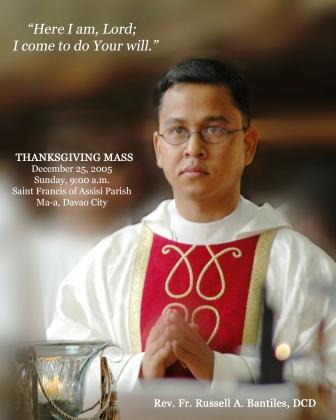
FR. RUSSELL BANTILES is helping the OFW’s of Tarragona organize and form a Catholic community where all members could lead good Christian lives. Twice in a month, the community celebrates the Holy Eucharist and the Sacrament of Confession in Tagalog, and receives catechism in the parish church of St. John, the Baptist. For a virtual tour to the Sanctuary, click this link: http://www.torreciudad.org .

It’s worth being a priest!

The sight of long, disorderly queues and of the slow flow of people passing through four metal detectors with its corresponding X-ray machines was frustrating. It was almost 8:00 AM and the possibility of entering quickly and finding a seat near the altar was practically null. We thought that arriving two hours before the Mass would begin was more than enough to get our objective. Obviously, hundreds thought that arriving three hours earlier was better.

Being smaller in stature (of course, with respect to towering Europeans) provided us a considerable edge. Quickly we were able to get near one of those detectors without being reprimanded for overtaking. The queues could not be defined and, in the midst of disarray, everybody would get nearer the entrance as one could muster. And successfully, we did it in just 30 minutes.

After passing through the metal detectors, there was another long line approaching a couple of security personnel. This time the flow was faster. Making good use of the time, we hurriedly put on our albs and stoles as we got nearer two guards inspecting our ID’s.

The security was quite tight. But they had more than enough reason to be so. They’re simply protecting their country, its head and its less than a thousand population from possible aggressors. Besides, that day was quite significant. An estimated 15,000 visitors were set to fill the 0.17 square mile area of the world’s smallest city-state. The host country wanted to treat its visitors with utmost hospitality.

At last, we were able to enter the main plaza. The sight of thousands of men gleaming in their white albs and stoles under the scorching early summer morning sun reminds one of John’s spectacular vision in the Book of Revelation. But there was little time to contemplate the scene as we headed immediately to find available seats near the altar. With gratitude we grabbed the first bottles of mineral water offered by some personnel along the way.

“Russell!” echoed a distinctly recognizable voice in the midst of a “babelic” noise. As I turned around, I caught sight of familiar faces: a total of 13 priests from the Diocese of Digos and one from my own Archdiocese of Davao, Fr. Bong Dublan. With Fr. John Paul Pedrera, my companion from Spain, I joined the group as they had the ideal location in the first block right in front the grand altar of St. Peter’s Square.

“How did you get to this place?” I asked. “We arrived here at seven o’clock!”.

When the choir intoned the Litany of Saints, their voice was drowned by a thunderous applause as the Head of the State approached the altar, preceded by a group of altar servers, deacons and cardinals. Since 1929, through a Lateran Treaty, Vatican is recognized as an Independent City State and the Pope as its Head.

Clad in his white cassock and magnificently embroidered chasuble and miter, and mounted on his usual papal jeep, Pope Benedict XVI waved and blessed the thousands of priests gathered around the Successor of St. Peter for the Eucharistic celebration that culminates the Year for Priests. Although the estimated number of 15,000 is just a fraction of the 409,000 priests who serve around the world, it sets a historical record. By all accounts, the event was heartwarming as many priests would testify.

As a 43-year-old priest from Lenzburg, Switzerland said: “We wanted to feel part of the community of all the priests. In Switzerland there are not many of us, so it is good to know we are not alone”. Definitely, the experience left an indelible mark in my priesthood.

* * *

“God makes use of us poor men in order to be, through us, present to all men and women, and to act on their behalf. This audacity of God who entrusts himself to human beings – who, conscious of our weaknesses, nonetheless considers men capable of acting and being present in his stead – this audacity of God is the true grandeur concealed in the word ‘priesthood’”.

These words with which the Pope Benedict XVI begun his homily set the hearts the priests on fire. Reflecting on what he calls the “audacity of God”, any priest would shiver at the thought that God has called him despite who and what he is. The Pope adds:

“That God thinks that we are capable of this; that in this way he calls men to his service and thus from within binds himself to them: this is what we wanted to reflect upon and appreciate anew over the course of the past year”.

True enough, the Year for Priests had also been an occasion maliciously exploited by those who wanted to destroy the Church and the gift of priesthood. While the Church, by declaring the Year for Priests, pays tribute to the grandeur of priesthood, there are those who wanted to dishonor the priests.

“It was to be expected” – the Pope continued – “that this new radiance of the priesthood would not be pleasing to the ‘enemy’; he would have rather preferred to see it disappear, so that God would ultimately be driven out of the world. And so it happened that, in this very year of joy for the sacrament of the priesthood, the sins of priests came to light – particularly the abuse of the little ones, in which the priesthood, whose task is to manifest God’s concern for our good, turns into its very opposite”.

But as one can notice rightly, the central element during the Year for Priests was not the individual priests themselves. Those who magnified the weaknesses and sins of a very small number of particular priests wanted to distort the significance of this event. The Year for Priests was not to give tribute to the majority of well-performing priests and to discredit the problematic few. The central element was priesthood itself, the epitome of which is Jesus Christ, the High Priest, the Only Priest.

The Pope emphasized it clearly: “Had the Year for Priests been a glorification of our individual human performance, it would have been ruined by these events. But for us what happened was precisely the opposite: we grew in gratitude for God’s gift, a gift concealed in ‘earthen vessels’ which ever anew, even amid human weakness, makes his love concretely present in this world”.

If the Year for Priests had left an indelible mark in my priesthood, it is because it taught me how to appreciate more my being a priest, an appreciation that grew intensely thanks to that experience in St. Peter’s Square together with my more or less 15,000 brother-priests. Such intense appreciation and profound gratitude to God for this gift of priesthood grow distinctly every day in God’s grace and especially amid the awareness of my human weaknesses.

At the outset, I said that the sight of long, disorderly queues is frustrating. But upon thinking that within these long rowdy lines are men dressed in black clergyman, the impression takes a 360-degree turn: it is worth being counted among these “earthen vessels” that contain God’s precious gift to man – PRIESTHOOD, the love of the heart of Jesus!


If I love my GF, why can’t I make love with her? (Part I)

Here’s an article that most “Romeos” would not want to read and most “Juliets” would ignore because it tackles some basic questions that today, most young people in love would not want to confront. “If sex is making love and if I love my girlfriend, why can’t I make love with her?” asks a seemingly fallen in love, 21-year-old guy.
Here’s the answer.

First, let me make it clear that I don’t doubt that adolescents and young adults really fall in love and that true love really occurs among young people. That is not the question here! But the first idea to clarify is: Is sex simply making love?

That is purely simplistic and superficial. Taking sex to mean love-making either misunderstands the true meaning of love or debases the dignity of sexual activity. Or both! Human sexuality is God’s gift. Hence, sex is sacred. God has only one purpose for giving it to man: one purpose with a double dimension – unitive and procreative. It means an expression of unity and love, and is intended for procreation. To separate these two dimensions is to go against the divine will. Understanding sex merely as making love separates the unitive from the procreative dimension. Besides, in the expression making love or love-making, it is not quite clear what does love means.

What is love? How should we understand the term? Pope Benedict XVI aptly observes that “Today, the term ‘love’ has become one of the most frequently used and misused of words, a word to which we attach quite different meanings” (Deus caritas est, 2). Those who understand love simply as that strong affection or emotion that draws us to the beloved have still a lot of reflection to do in order to understand better the term (or the experience of true love).

I think, the Pope’s description is easy to follow and understand. He distinguishes two dimensions of love: eros and as agape. The former, as understood by the Greeks, is described as “That love between man and woman, which is neither planned nor willed, but somehow imposes itself upon human beings... The Greeks—not unlike other cultures—considered eros principally as a kind of intoxication, the overpowering of reason by a ‘divine madness’ which tears man away from his finite existence and enables him, in the very process of being overwhelmed by divine power, to experience supreme happiness” (Ibid.).

In our contemporary language, we call this experience “falling in love”, in which the person in love feels being engulfed by a pleasant sensation whenever he/she is with the beloved, experiences sleepless nights thinking of the beloved and reminiscing the last time they were together, desires to be always with the beloved and could not endure the thought of not seeing the beloved. To most naïve young lovers, the maximum expression and manifestation of this affection is sexual intercourse. That is why, they call it “love-making”. But in reality, it is just the first phase or dimension of true love – it is simply eros, from which comes the term erotic love.

The danger that lies in this phase is believing that all love is simply this: having a pleasant feeling, wanting the presence of the beloved, love-making to satisfy that longing for sexual union. It is dangerous because not only it degrades the true meaning of love, but also because it debases the person and prevents one from ascending to the experience of true love and human relationship. When eros is abused, the person is degraded and true human relationship is broken.

The Pope says: “An intoxicated and undisciplined eros, then, is not an ascent in ‘ecstasy’ towards the Divine, but a fall, a degradation of man. Evidently, eros needs to be disciplined and purified if it is to provide not just fleeting pleasure, but a certain foretaste of the pinnacle of our existence, of that beatitude for which our whole being yearns”.

If we want really to express true love towards our beloved, what is required is to discipline the eros, the erotic desires and affections. Thus, we come to the first answer to the question: “If I love my GF, why can’t I make love with her?” Because making love with her is not an expression of your true love. Simply, it is a manifestation of your eros, which you need to discipline and purify. To make love with her (outside marriage) is not to respect her. The absence of respect to the person of the beloved is exactly the opposite of true love. If you “make love” with your GF, then you don’t really love her. If you insist that you do, you are simply insisting on a lie. And that makes you more than a liar, someone not worthy to be trusted.

Everything said here goes true also to the woman who consents in the act. It takes two to tango, they say. Both man and woman are mistaken – deceived – in thinking that, indulging in premarital sex, they express true love to each other. What they simply do is indulge themselves into finding satisfaction for their selfish erotic desires, using each other as instruments. What each is seeking for in premarital sex is self-satisfaction under the guise of expressing love.

Why? Because true love between man and woman is forever and exclusive. These notes – “only with this person” (exclusivity) and “being forever” – are not guaranteed in premarital sex. Only the Sacrament of Matrimony can guarantee them. Thus, only within marriage can sexual activity be truly an expression of true love between man and woman. Only in marriage God allows the use of this sacred gift, that is, sex. (to be continued)

Friday, December 18, 2009

What’s happening in Maguindanao?

Over a month of literary slumber (I have not written for a month in my column in The Davao Catholic Herald, named Cogito) is shaken and awakened by the horrors of Maguindanao carnage, of such repugnance that it could even make a mute shout.

In these last few days, everyone here in Pamplona (those who know that I am from Mindanao) is asking me, “¿Qué está pasando allí en tu tierra?” (What’s going on there in Mindanao?). Full of embarrassment, I simply answered with a deep sigh and asked them to pray hard for my land.

Everybody’s question is: how is it possible for man to plan and execute such a barbaric act? Looking at every detail of it – from the way the victims are abused (especially the women), tortured and killed up to the manner of trying to hide the crime, dumping them on shallow improvised graves – one could make an idea of the abysmal darkness that lurks in the concience of the mastermind.

How is it possible? It is only possible when God is absent in that concience. As the Second Vatican Council teaches, when God is absent in human horizon, not only does man vanish but also he turns against himself; he becomes autodestructive and turns into a beast for his fellowman.

I am one with those who explicitly condemned these brutal killings. I joined the voice of those who cry for justice in behalf of the victims, whose blood – like that of Abel – is clamoring to heaven. Filled with indignation, I also contemplate painfully this heartbreaking incident.

But with a firm grip on my Christian faith, I know “God can write straight with crooked lines” and that, if God allowed this to happened – as He could never will evil things to occur – in the words of St. Paul, “Everything works for the good of those who love the Lord”.

As faithful Christians, what are we to do aside from condemning reasonably the crime and demanding rightly justice? Let us cling to God’s mercy and grab God’s hand more firmly, knowing that all our hope is in God alone. But in saying this, I am not suggesting a certain kind of passive reaction – a mere shrugging of shoulders. Prayer is more efficient and powerful than action.

Let us not content ourselves with condemning this evil act – let us condemn all evil of this kind! I am saying this because it is very scandalizing to hear people and institutions condemning the Maguindanao massacre, yet would not even raise a voice against the rampant abortion happening around the world. I am not diverting attention here, just widening our perspective of what is evil.

Besides, let us not be contented with condemning the evils outside of us – we should not forget to condemn also the evils that we carry within us. Because the evils that we see around are mere reflections of the evils that man – by keeping himself away from God – has succumbed himself to.

We denounce rightly this evil in Maguindanao. But don’t you think we need also to denounce our own personal evils – our sins – in the Sacrament of Confession? Perhaps, in doing so, God will have pity on us and will put an end to these exterior evils. Only when man is purified from his interior evils can the evils of this world be eradicated!

And you might rightfully say, “The perpetrators, the criminals should be the first to purify themselves – confess their crime and suffer the punishment!” That may be the ideal thing. But it is not a matter of who’s to do it first! What’s important is that everyone does what corresponds to him: condemn evil – outside and inside of him.

Perhaps, it is the “straight line” or the “good” that can be gleaned from this horrifying crime. One day, Jesus asked His disciples, “Do you think those people Herod decapitated are more sinful because they have fallen into such a sad fate? Of course, not. But if you will not repent, you too will experience the same.”

Never do we think that the Maguindanao victims are more sinful than us because they suffer such fate. But yes, we agree that what occurred to them is a frightful evil, as frightful as our personal sins. The only true evil, says St. Augustine, is moral evil, that is, our sins. How I wish I could feel as dreadful towards the horror of my sins as I do towards this heinous crime!

Why this heinous crime? The answer is neither too impersonal nor too enigmatic. Heinous crimes are always possible for people who have let God slipped off their concience, who have denied God a little room in their heart, who have never felt any repulsion towards any minimal offense against God. A heart that has no room for God is never neutral – it is always filled with evil. St. Augustine says, “We are all capable of all heinous crimes in the world. But thanks to God’s grace we are preserved from them”.

Friday, October 2, 2009

“What is the Gospel for today?”

“What is the Gospel for today?” The question seems to be very simple and easy to answer. But if I tell you the context, you’d understand my bit of surprise when I was asked this question.

It came from a woman pilgrim, who came from London – with two other Irish women friends – to do the “Camino de Santiago”, the famous pilgrimage by foot to Santiago de Compostela where the tomb of St. James, the Apostle (the Older) lies. Prior to this question, I asked them who was the last person in the queue going to the camarín (an altar that contains the statue of the Apostle which pilgrims embrace upon their arrival at the Cathedral).

Perhaps, the British woman recognized that I am a priest. So she immediately dropped the question that almost caught me off-guard!

* * *

Did it happen to you that sometimes you can’t recall the Gospel of the day that you heard in the early morning mass, especially when you are asked about it at the last hour of the day? That was what almost occurred to me!

I said “almost” because – thanks to my guardian angel – I immediately recalled that the last part of that day’s Gospel (it was a Thursday) was the topic of the priest’s commentary during the Bible sharing we had at midday: Herod wanted to see Jesus out of curiosity.

Remembering the priest’s sharing has saved me from shame! So immediately, I started to narrate to the lady the Gospel passage. I carefully distinguished this Herod from the other one who – during Jesus’ infancy – wanted to see the Child to kill Him. This Herod in the day’s Gospel wanted to see Jesus because he thought Jesus was the same John the Baptist whom he had decapitated.

* * *

“Who is Herod today?” the British lady interrupted my narration. “Excuse me?” I didn’t get, at first, her question, engrossed in my narration. “Who is Herod today?”

I understand, the lady did not only ask for the Gospel reading: she was also asking for a homily! We were already in the middle of the long queue. In a few minutes, we were about to ascend to the Apostle’s camarín. (It has to be short homily, I said to myself!)

“Herod,” I began, “can be everyone of us”. I could immediately perceive how wrinkles began to form in the women’s forehead. “You and I, we also want to see Jesus. That’s why we are here in the Cathedral of Santiago de Compostela.” The wrinkles slowly vanished.

“But our attitude, our motive of wanting to see Jesus must be different from that of Herod’s”, I continued, inspired by the effect my introduction has produced. “He wanted to see Jesus out of curiosity; we want to encounter the Lord because we believe and are convinced that only in Him can we find true happiness that we are searching for.”

Had we not reached the camarín and had not the three women started to go up, I should not have known how to end my “homily”!

* * *

What this experience taught me is this: be always prepared! I mean, we, priests, have to make good use of every opportunity presented to us to talk to people about God, about the Good News. And this requires good preparation.

I couldn’t imagine what could have been the end of that encounter had I answered “I forgot” to the question “What is the Gospel for today?” It could have been very embarrassing especially if the inquirer is someone who looks up to priests whom he or she expects to share some reflections about the Word of God.

In my experience, the Gospel for the day can easily be forgotten if it is not meditated seriously (especially before the celebration of the mass) and proclaimed attentively during the celebration. Giving a short homily helps the priest a lot in internalizing the Gospel’s message.

As a young priest, once again, I admit there are still a lot of things to learn in the priestly ministry. Experiences like this teach me lessons that even the seminary could not impart!

Monday, September 21, 2009

Elegant service

“Encomiéndeme, Padre, por favor, que estoy pasando mal” (Father, please pray for me; I am having a hard time).

With her accent, I was almost sure she is from Equator, South America. Besides, she was well-dressed, so no one could suppose that she’s one of these modern beggars, who would deliberately appear grimy so as to move generous philanthropists into pity.

But she was smiling while she shamelessly presented to me her simple petition: to pray for her. We almost bumped into each other on the street. As I was coming out from the Police Headquarters, renewing my residence ID, she made her sudden presence out of nowhere.

It called my attention for I seldom see people who are having a hard time wear such a patient smile on their face. Besides, I seldom get petitions for prayer on the street from total strangers.

* * *

How did she know I am a priest? By the black clerical suit that I was wearing. Indeed, people nowadays need to see concrete and visible symbols of Christ’s presence on the streets, especially in times when they feel the world is going upside down.

We understand well why when there is a high level of insecurity in the city – after, perhaps, a terrorist attack or a bomb explosion – police officers would immediately make their presence felt. We see military and policemen around. And we feel safe (or agitated, depending on the person’s interpretation of the scene).

In the same analogical manner, why can’t we, priests, make our presence felt in a society where there is an increasing level of spiritual uncertainty and confusion? Perhaps, through visible signs like the simple wearing of clerical shirt, people may be reminded of the presence of God in their worst moments.

* * *

“Why would a priest not wear clerical shirt as strongly recommended by the Church?”

It came to my mind a very lively discussion I had with my Peruvian priest-friend last year regarding this topic. He said, priests who refuse to wear priestly garb lose this great opportunity of evangelizing people through these visible signs. But I argued that there are also instances when not wearing clerical is preferrable.

There are persons who are too anti-clerical (especially here in Spain) that, by simply perceiving a coming clergyman, would immediately begin to bawl using foul language. Effectively, the visible symbol of God’s presence – the priest – turns out to be something that provokes their antipathy. My friend was speaking in general terms; I was focused on a particular case. But like him, I too believe that even in this smallest detail, we, priests, need to give testimony to who we are. Yet I refuse to mean to be too rigid in this aspect. Prudence still remains a better option.

* * *

“No se puede parar de trabajar cuando uno anda por la calle en ‘clergyman’” (A priest could not cease to fulfill his ministry whenever he walks on the street in priestly garb), commented one priest here in Santiago de Compostela, Spain. (I’m here for a week of priestly formation). He referred to his experience one morning, when he and another priest were trying to reach the entrance of the Cathedral. Some groups of pilgrims approached them for various motives: to ask for a blessing of religious articles, for some information, or even to ask for confession.

Indeed, our priesthood does not end at the door of our parish church nor does it cease as the parish office closes. We still remain priests even if we put on T-shirt and basketball shorts. Yet we seem to enjoy stories of convent boys, extra-ordinary ministers of communion or even a simple parishioner of another parish mistaking us for a priest’s driver simply because they see us wearing sleeveless shirts even during office hours.

I think we owe it to our parishioners and to the lay faithful in general to maintain an elegant look that is asked for by justice and by the dignity of our vocation. To them, we represent Christ. For them, we are “alter Christus” (even “ipse Christus” especially in the celebration of the sacraments). As Vatican II affirmed, our ministerial priesthood is at the service of the common priesthood. I think, it is our duty to serve the lay faithful as elegantly as possible.

Tuesday, September 15, 2009

A life well-lived

Reading a very thought-provoking book of our professor, a Spanish philosopher Alejandro Llano, entitled “La vida lograda” (A life well-lived), I could not help but dedicate a few moments digesting his ideas. I thought I might as well provoke you, my dear readers, to think, so I decided to share these thoughts with you.

* * *

“Examinar qué es lo que me hace crecer en cuanto persona y qué es aquello con lo que yo mismo me puedo dañar y malograr mi vida” (Examine what makes me grow as a person and what is that which harms me and turns my life into a waste.)

It’s another way of expressing what Socrates declared long time ago: “An unexamined life is not worthliving”. It is part of our human nature to keep ourselves away from harm and to cling to what keeps us whole and fulfilled. Yet, the difficulty nowadays is that most harmful things present themselves under the guise of what is pleasurable and comfortable.

* * *

“Es joven toda aquella, todo aquél, para quien el futuro presenta mayor interés que el pasado” (Young is he or she to whom the future is more interesting than the past.)

The old ones say: “The problem with the youth is that they always talk about their future – their dreams, plans, ambitions, fantasies, etc”. Then, the youth replied: “The problem with old people is that they keep on remembering their past – adventures, achievements, etc.

If you think the past (especially your past) is better than the future (especially your future) and if you keep on saying that the days past are better-off than today and that tomorrow will be worse (especially when you say it with the certainty of the sun shining every morning), then, I’m sure you are already old.

* * *

“Para saber lo que debemos hacer, hemos de hacer lo que queremos saber” (In order to know what we should do, we should do what we want to know.)

It may appear like a word game. But its message is very simple: let’s put into practice what we know (or want to know). “By nature, man desires to know”, says Aristotle. And man wants to know only the good (at least, what is good for him) for, as the same philosopher says, “no man willingly does wrong.”

However, it’s useless to know anything if our knowledge does not lead us to action, if our knowledge does not tell us what to do. “In order to know what we should do, we should do what we want to know”.

* * *

“Lo decisivo no es sentir; lo decisivo es pensar” (What is decisive is not to feel but to think.)

If only the majority would base their life’s decisions on what they have thought of rather than what they felt, a lot of problems (especially emotional and relational ones) would be avoided or solved. But most people today make decisions based on feelings, not so much on rational deliberations.

Worst, the movements of one’s emotions (which are fluctuating) are interpreted as a sign of the right thing to do, the guide of one’s decision-making. “What’s important is I feel good,” said one friend of mine over the net. And I responded: “To feel good is the least; what’s important is to be good.”

* * *
“Hay que discutir las ideas y no criticar a las personas” (We should discuss and criticize ideas not persons).

People will not be motivated to correct their errors if criticisms are directed against their person (we call it “argumentum ad hominem”) rather than towards their errors or mistakes. A student is better motivated to study more if you tell him: “Your answer to this mathematical problem is wrong because the formula you used lacks one element”, rather than “Bobo ka kasi!” (You’re stupid!).

In our politics, in our movie industry, even in our neighborhood, in our workplace, we can observe a lot of “argumentum ad hominem” in our comments on one another. What is worst, we get used to it to the point that we could not distinguish anymore an argument (or a criticism) against an idea from that which is against a person. When our friend tells us that we are wrong in saying that Noynoy Aquino is running for president, at times we immediately react saying: “Ibig mong sabihin sinungaling ako?” (So you think I’m a liar?)

"Sacerdotes, 'consagrados en la Verdad'"

Estar inmersos en la Verdad, en Cristo, de este proceso forma parte
la oración, en la que nos ejercitamos en la amistad con Él y aprendemos a
conocerle: su forma de ser, de pensar, de actuar. Rezar es un caminar en
comunión personal con Cristo, exponiendo ante Él nuestra vida cotidiana,
nuestros logros y nuestros fracasos, nuestras fatigas y nuestras alegrías -es un
simple presentarnos a nosotros mismos ante Él. Pero para que esto no se
convierta en un autocontemplarse, es importante que aprendamos continuamente a
rezar rezando con la Iglesia.